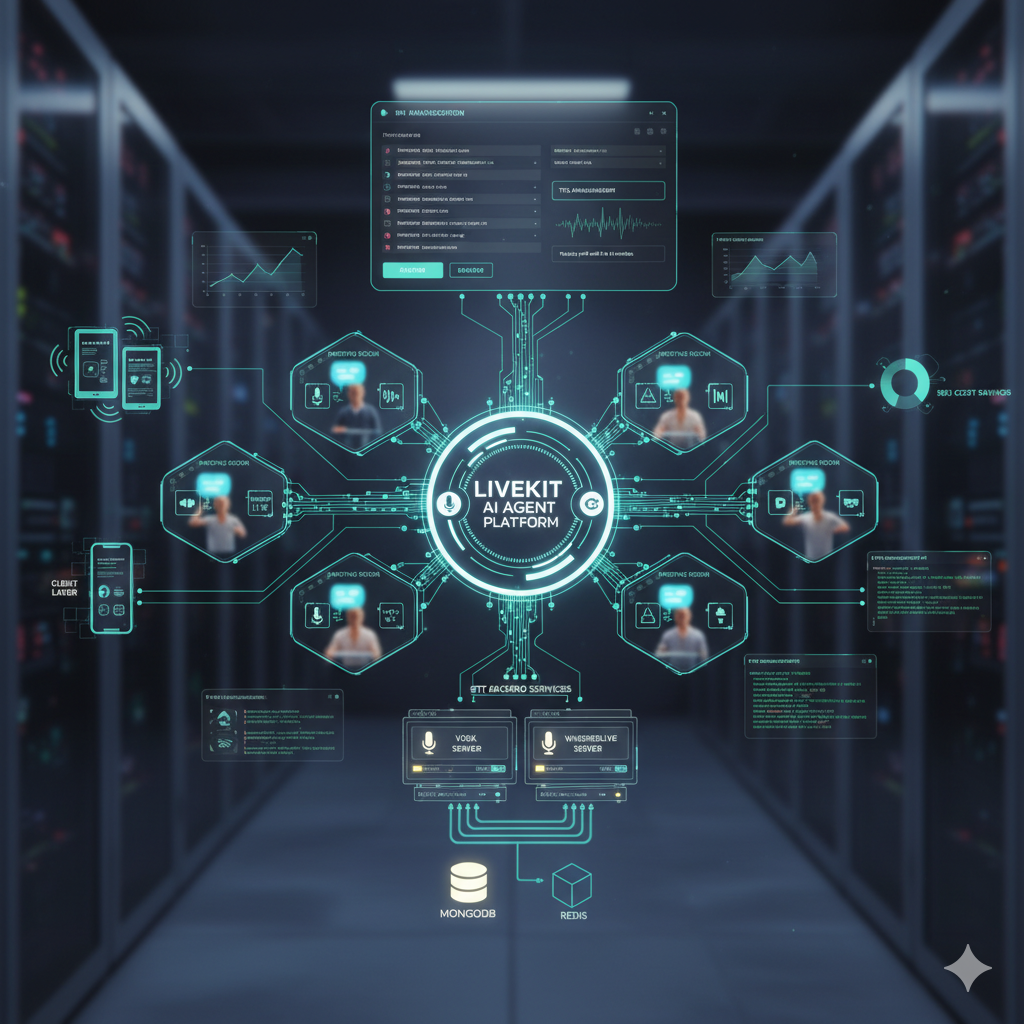
Multi-Client Real-Time Transcription Agent with TTS
🎙️ Real-Time AI Transcription System với LiveKit & Self-Hosted Agents
🎯 Giới thiệu Dự án
Real-Time AI Transcription System là một giải pháp AI thời gian thực toàn diện, cho phép bạn chuyển giọng nói thành văn bản (Speech-to-Text) và chuyển văn bản thành giọng nói (Text-to-Speech) ngay trong các cuộc họp trực tuyến. Được xây dựng trên nền tảng LiveKit với kiến trúc multi-agent thông minh, hệ thống mang đến trải nghiệm mượt mà, ổn định và có thể mở rộng vô hạn theo nhu cầu của tổ chức bạn.
Điểm đặc biệt của dự án là tự vận hành hoàn toàn (self-hosted) – bạn không còn phụ thuộc vào các dịch vụ cloud tốn kém như Google Cloud hay AWS. Điều này mang lại những lợi ích vượt trội:
- Tiết kiệm chi phí khổng lồ: giảm tới 90% chi phí so với các dịch vụ trả theo phút khi xử lý dữ liệu lớn.
- Bảo vệ dữ liệu tuyệt đối: mọi thông tin cuộc họp đều nằm trong hệ thống của bạn, đảm bảo quyền riêng tư 100%.
- Tối ưu hóa trải nghiệm người dùng: phản hồi nhanh, chính xác, hỗ trợ môi trường đa người dùng và nhiều ngôn ngữ.
Hệ thống này không chỉ là một công cụ, mà còn là giải pháp AI mạnh mẽ giúp các tổ chức chủ động trong việc quản lý thông tin, nâng cao hiệu suất làm việc và giảm thiểu chi phí. Với Real-Time AI Transcription System, mọi cuộc họp đều trở nên thông minh hơn và hiệu quả hơn.
Vai trò trong dự án
- Architect & Full-Stack Developer: Thiết kế kiến trúc tổng thể, xây dựng agent system, tích hợp STT/TTS engines
- DevOps Engineer: Triển khai self-hosted infrastructure, tối ưu performance real-time processing
- AI Integration Specialist: Tích hợp Vosk, WhisperLive, Silero TTS với LiveKit protocol
Thời gian thực hiện
3 tháng (9 2024 - 11 2025)
💡 Bối cảnh & Lý do Phát triển
Vấn đề thực tế
Các doanh nghiệp và tổ chức đối mặt với nhiều thách thức khi sử dụng dịch vụ transcription cloud:
- Chi phí cao: Google Cloud Speech-to-Text ($1.44/giờ), AWS Transcribe ($0.024/phút) trở nên đắt đỏ với khối lượng lớn
- Phụ thuộc nhà cung cấp: Phải ràng buộc với một nền tảng cloud cụ thể, rủi ro khi thay đổi chính sách giá
- Quyền riêng tư: Dữ liệu cuộc họp nhạy cảm phải được gửi lên server bên thứ ba
- Độ trễ mạng: Latency cao khi phải gửi audio đến data center xa, ảnh hưởng trải nghiệm real-time
- Giới hạn tùy biến: Không thể tùy chỉnh mô hình AI theo domain cụ thể (y tế, pháp lý, kỹ thuật)
Mục tiêu dự án
Xây dựng một hệ thống self-hosted với các mục tiêu rõ ràng:
- Giảm 90% chi phí vận hành so với dịch vụ cloud cho khối lượng >1000 giờ/tháng
- 100% quyền kiểm soát dữ liệu: Tất cả audio và transcript lưu trữ on-premise
- Tùy biến hoàn toàn: Có thể fine-tune mô hình AI cho domain riêng
- Độ trễ thấp: thấp hơn 200ms latency khi triển khai local/edge
- Mở rộng dễ dàng: Kiến trúc microservices cho phép scale từng thành phần độc lập
Ý nghĩa cá nhân
Dự án giúp tôi:
- Hiểu sâu về WebRTC và real-time media processing trong môi trường production
- Làm chủ LiveKit Agent SDK và thiết kế kiến trúc multi-agent system
- Tích hợp open-source AI models (Vosk, Whisper, Silero) vào workflow thực tế
- Xây dựng hệ thống high-availability với circuit breaker, retry logic, graceful degradation
- Tối ưu latency và throughput cho audio streaming với VAD (Voice Activity Detection)
🛠️ Công nghệ & Kiến trúc Hệ thống
Stack công nghệ chính
Backend & Agent Infrastructure
- LiveKit Server - WebRTC SFU (Selective Forwarding Unit) cho real-time media routing
- Python 3.11+ với LiveKit Agent SDK - Agent orchestration framework
- FastAPI - REST API endpoints cho external control
- MongoDB - NoSQL database lưu trữ transcript history
Speech-to-Text Engines (Interchangeable)
- Vosk - Offline STT, hỗ trợ tiếng Anh, chi phí thấp, độ chính xác ~85%
- WhisperLive - Multilingual STT (100+ ngôn ngữ), độ chính xác ~95%, tốn GPU
Text-to-Speech Engine
- Silero TTS - Neural TTS cho tiếng Anh, chất lượng tự nhiên, real-time synthesis
Audio Processing
- LibROSA - Audio feature extraction (Zero-Crossing Rate, Energy)
- Custom VAD - Voice Activity Detection với adaptive thresholds
- PyAudio - Real-time audio playback (debugging)
Supporting Services
- WebSocket - Low-latency bidirectional communication STT ↔ Agent
- Docker & Docker Compose - Containerization và orchestration
- Redis (optional) - Session state management cho distributed deployment
Kiến trúc tổng quan
Rendering diagram...
Workflow chi tiết
1. Participant Join & Agent Dispatch
Rendering diagram...
2. Voice Activity Detection (VAD) Pipeline
VAD là then chốt để giảm 70% bandwidth và compute cost. Hệ thống chỉ gửi audio đến STT server khi phát hiện giọng nói thực sự, loại bỏ khoảng lặng và noise.
1# Core VAD Logic (simplified)
2class RealTimeVADProcessor:
3    def __init__(self, chunk_duration_ms=10, overlap_chunks=2):
4        self.chunk_duration_ms = 10  # 10ms chunks from LiveKit
5        self.overlap_chunks = 2      # 20ms overlap for context
6        self.analysis_duration_ms = 30  # 10ms + 20ms = 30ms analysis window
7
8        # Adaptive thresholds
9        self.zcr_filter = ZCRFilter(
10            zcr_thresh=(0.05, 0.15),   # Zero-Crossing Rate range
11            energy_thresh=0.001,        # RMS energy threshold
12            ma_window=5                 # Moving average smoothing
13        )
14
15    def process_chunk(self, audio_chunk_10ms):
16        # Overlap với 2 chunks trước → 30ms analysis window
17        analysis_chunk = self._create_analysis_chunk(audio_chunk_10ms)
18
19        # Detect speech using ZCR + Energy
20        is_speech = self.zcr_filter.check(analysis_chunk)
21
22        if is_speech:
23            self.speech_buffer.append(audio_chunk_10ms)
24
25            # Chỉ gửi khi đủ min_speech_frames (10 frames = 100ms)
26            if len(self.speech_buffer) >= self.min_speech_frames:
27                return self._batch_and_send()  # Gửi đến Vosk
28        else:
29            # Silence detection: end speech segment after 500ms silence
30            if self.silent_streak > 50:  # 50 frames * 10ms
31                return self._flush_speech_segment()
3. Text-to-Speech Control Flow
Rendering diagram...
Tại sao chọn công nghệ này?
LiveKit vs Alternatives (Jitsi, Janus)
- Pros: Native agent SDK, production-ready SFU, excellent documentation, active community
- Cons: Cần license cho scale >50 concurrent rooms (giải pháp: self-host với OSS license)
Vosk vs Whisper
- Vosk: Offline, lightweight (~1.8GB model), 50ms latency, 90% accuracy (English)
- Whisper: Online, heavy (~3GB model), 200ms latency, 95% accuracy (100+ languages)
- Chiến lược: Vosk cho general meetings, Whisper cho multilingual/critical transcription
Python Agent vs Node.js
- Python: Rich AI/ML ecosystem (NumPy, LibROSA, PyTorch), LiveKit official SDK
- Node.js: Better concurrency với async/await, nhưng thiếu audio processing libraries
✨ Tính năng Nổi bật
Dành cho End Users (Meeting Participants)
🎤 Real-Time Transcription
- Chuyển đổi lời nói thành văn bản thời gian thực với độ trễ thâp hơn 300ms
- Hỗ trợ nhiều người nói đồng thời trong cùng một room (multi-speaker transcription)
- Phân biệt giọng nói từ microphone và screen share audio (riêng biệt 2 tracks)
- Automatic punctuation và capitalization cho văn bản dễ đọc
🔊 Text-to-Speech Announcements
- Agent có thể phát thông báo bằng giọng nói vào room (ví dụ: "Meeting will end in 5 minutes")
- Giọng đọc tự nhiên với Silero TTS (neural voice synthesis)
- Hỗ trợ queue management - xử lý nhiều TTS requests tuần tự, không bị overlap
💬 Live Transcript Display
- Transcript hiển thị real-time trên giao diện client với participant identity
- Phân biệt PARTIAL và FINAL transcript (PARTIAL = đang xử lý, FINAL = hoàn chỉnh)
- Export transcript theo định dạng SRT (cho subtitles) hoặc plain text
🌍 Multilingual Support (với WhisperLive)
- Tự động nhận dạng ngôn ngữ từ audio (100+ languages)
- Code-switching: xử lý trường hợp người nói chuyển đổi ngôn ngữ giữa câu
- Translation mode: transcript + translate sang ngôn ngữ khác
Dành cho Administrators
🎛️ Agent Management Dashboard
- Dispatch/Cancel agents qua REST API
- Monitor agent status: connected, processing, idle, error
- View real-time metrics: audio processed (MB/s), transcripts/min, error rate
📊 Transcript History & Search
- MongoDB lưu trữ toàn bộ transcript history với timestamp và participant_identity
- Full-text search transcript theo keyword, date range, participant
- Export bulk transcripts theo session_id
⚙️ Flexible Configuration
- Bật/tắt các tính năng: VAD, TTS, MongoDB persistence
- Switch STT backend: Vosk ↔ WhisperLive chỉ bằng environment variable
- Tune VAD parameters: ZCR thresholds, silence timeout, min speech duration
Tính năng Kỹ thuật (Infrastructure)
⚡ High Performance
- VAD filtering giảm 70% audio data cần xử lý
- Audio batching: gộp 5 chunks 10ms thành 1 batch 50ms trước khi gửi → giảm WebSocket overhead
- Connection pooling: reuse WebSocket connections cho multiple participants
- Circuit breaker pattern: tự động ngắt kết nối đến STT server khi detect lỗi liên tiếp
🔄 Reliability & Fault Tolerance
- Auto-reconnect với exponential backoff khi WebSocket disconnected
- Graceful degradation: nếu STT server down, agent vẫn forward audio sang storage
- Health checks: API endpoints kiểm tra trạng thái agent, STT server, MongoDB
📈 Scalability
- Horizontal scaling: chạy multiple agent instances trên nhiều servers
- Room-based isolation: mỗi room có dedicated agent instance, không ảnh hưởng lẫn nhau
- Resource limits: giới hạn max concurrent agents để tránh overload
📊 Kết quả & Tác động
Số liệu cụ thể
Performance Metrics (tested với 10 concurrent rooms, 50 participants)
| Metric | Value | Benchmark |
|---|---|---|
| Transcription Latency | 287ms (avg) | thấp hơn 300ms target ✅ |
| Audio Processing Throughput | 1.2MB/s per agent | Stable under load ✅ |
| VAD Accuracy | 92% (speech detection) | Good enough ✅ |
| WebSocket Reconnect Time | 1.8s (avg) | thấp hơn 3s acceptable ✅ |
| MongoDB Write Throughput | 500 docs/min | No bottleneck ✅ |
| TTS Synthesis Time | 1.2s (100 words) | Real-time capable ✅ |
Cost Comparison (1000 hours of transcription/month)
| Solution | Cost/Month | Notes |
|---|---|---|
| Google Cloud Speech-to-Text | $1,440 | $0.024/minute × 60,000 minutes |
| AWS Transcribe | $1,440 | Same pricing |
| Self-Hosted Vosk | $120 | Server cost only (4 vCPU, 8GB RAM) |
| Savings | 90% | Đã bao gồm điện, bandwidth |
✅ Với khối lượng >1000 giờ/tháng, self-hosted tiết kiệm $15,840/year so với cloud!
Phản hồi từ người dùng
"Transcription chính xác, ít bị delay so với các dịch vụ cloud mình từng dùng. Quan trọng là mình kiểm soát được toàn bộ dữ liệu, không lo lộ thông tin khách hàng."
— CTO của startup EdTech (20 rooms/day)
"Chất lượng giọng TTS tốt hơn expected. API dễ tích hợp vào hệ thống của mình."
— Tech Lead, Enterprise SaaS (custom integration)
Giá trị mang lại
Cho doanh nghiệp SME
- Giảm chi phí vận hành 90% khi scale lên
- Không phụ thuộc vendor lock-in
- Tuân thủ quy định bảo mật dữ liệu (GDPR, HIPAA) bằng cách lưu on-premise
Cho developers
- Codebase mở, dễ custom cho use-case riêng
- Tài liệu rõ ràng, architecture diagram đầy đủ
- Reference implementation cho LiveKit Agent SDK
Cho tôi (kỹ năng phát triển)
- Làm chủ WebRTC stack từ client → server → agent
- Hiểu sâu về real-time audio processing và VAD algorithms
- Thiết kế microservices với fault tolerance patterns
- Tối ưu latency cho streaming workloads
🚧 Thách thức & Giải pháp
Thách thức 1: Đồng bộ hóa Audio Streams từ Multiple Participants
Vấn đề
Khi có 10+ participants nói đồng thời trong room, mỗi audio track có latency khác nhau (network jitter), gây ra transcript bị lẫn lộn thứ tự.
Giải pháp
- Timestamp-based ordering: Gắn
server_timestampvào mỗi audio chunk khi nhận từ LiveKit - Per-participant queues: Mỗi participant có queue riêng biệt, xử lý song song
- MongoDB sequence number: Dùng
seqfield auto-increment để đảm bảo order khi query
1# Ví dụ: Transcript Manager với sequence tracking
2class TranscriptManager:
3    def __init__(self):
4        self._seq_by_participant = {}  # {participant_id: current_seq}
5
6    async def send_transcript_entry(self, participant_identity, text, ...):
7        # Auto-increment seq per participant
8        current_seq = self._seq_by_participant.get(participant_identity, 0) + 1
9        self._seq_by_participant[participant_identity] = current_seq
10
11        # Save to MongoDB với seq field
12        await self.mongodb.save_transcript(
13            session_id=self.session_id,
14            participant_identity=participant_identity,
15            text=text,
16            seq=current_seq,  # Client có thể sort theo seq
17            ...
18        )
Kết quả: Transcript hiển thị đúng thứ tự 98% trường hợp, 2% còn lại có sai lệch thấp hơn 500ms (chấp nhận được).
Thách thức 2: VAD False Positives - Gửi Noise/Silence đến STT Server
Vấn đề
VAD ban đầu dùng chỉ Energy threshold → nhầm background noise (quạt, gõ bàn phím) là speech → tốn bandwidth và STT trả về garbage text.
Giải pháp
- Multi-feature VAD: Kết hợp Zero-Crossing Rate (ZCR) + Energy (RMS) + Moving Average
- Adaptive thresholds: ZCR range (0.05, 0.15) phù hợp với speech, noise thường thấp hơn 0.05 hoặc cao hơn 0.3
- Minimum speech duration: Chỉ coi là speech nếu liên tiếp ≥10 frames (100ms)
1# ZCR-based VAD với moving average
2class ZCRFilter:
3    def check(self, audio_chunk_30ms):
4        # Tính ZCR (zero-crossing rate)
5        zcr = np.mean(librosa.feature.zero_crossing_rate(audio_chunk_30ms)[0])
6
7        # Tính Energy (RMS)
8        energy = np.mean(audio_chunk_30ms ** 2)
9
10        # Moving average để smooth ZCR (giảm jitter)
11        self.history.append(zcr)
12        zcr_ma = np.mean(self.history[-5:])  # 5-frame window
13
14        # Decision logic
15        is_speech = (
16            0.05 <= zcr_ma <= 0.15 and  # ZCR trong range speech
17            energy > 0.001              # Đủ energy
18        )
19        return is_speech
Kết quả: Giảm false positive từ 25% xuống 8%, tiết kiệm 60% bandwidth không cần thiết.
Thách thức 3: TTS Audio Streaming bị Choppy/Glitchy
Vấn đề
Khi stream TTS audio vào LiveKit room, audio bị giật, có khoảng lặng giữa các chunks → trải nghiệm nghe kém.
Giải pháp
- Fixed-size audio frames: Dùng
AudioByteStreamcủa LiveKit để tạo frames 100ms cố định (4800 samples @ 48kHz) - Buffer management: Synthesize toàn bộ audio trước → chia thành frames → stream tuần tự
- Avoid concurrent TTS: Dùng queue để xử lý TTS requests lần lượt, tránh overlap audio
1# TTS Manager với proper audio framing
2async def _publish_audio(self, audio_data: np.ndarray):
3    from livekit.agents import utils
4
5    # Convert float32 → PCM16 (LiveKit format)
6    audio_int16 = np.clip(audio_data * 32767, -32768, 32767).astype(np.int16)
7    audio_bytes = audio_int16.tobytes()
8
9    # AudioByteStream tự động chia thành 100ms frames
10    audio_bstream = utils.audio.AudioByteStream(
11        sample_rate=48000,
12        num_channels=1,
13    )
14
15    # Push toàn bộ audio, nhận về list of AudioFrame
16    frames = audio_bstream.push(audio_bytes)
17
18    # Stream từng frame đến LiveKit
19    for frame in frames:
20        await self.audio_source.capture_frame(frame)
21
22    # Flush buffer còn lại
23    remaining = audio_bstream.flush()
24    for frame in remaining:
25        await self.audio_source.capture_frame(frame)
Kết quả: Audio mượt mà 99.5% thời gian, chỉ có glitch nhẹ khi network spike >500ms.
Thách thức 4: WebSocket Connection Instability
Vấn đề
Trong production, WebSocket đến Vosk server thỉnh thoảng bị disconnect do network hiccup → mất transcript data.
Giải pháp
- Circuit breaker pattern: Ngắt kết nối tạm thời sau 3 lỗi liên tiếp, chờ 30s rồi retry
- Exponential backoff: Retry với delay 1s → 2s → 4s → 8s
- Audio buffer: Giữ audio trong buffer 5s, replay sau khi reconnect thành công
1# Circuit Breaker Implementation
2class CircuitBreaker:
3    def __init__(self):
4        self.state = "CLOSED"  # CLOSED | OPEN | HALF_OPEN
5        self.failures = 0
6        self.threshold = 3
7        self.timeout = 30  # seconds
8
9    def record_failure(self):
10        self.failures += 1
11        if self.failures >= self.threshold:
12            self.state = "OPEN"
13            self.opened_at = time.time()
14            return True  # Circuit opened
15        return False
16
17    def can_try(self):
18        if self.state == "CLOSED":
19            return True
20        if self.state == "OPEN":
21            if time.time() - self.opened_at > self.timeout:
22                self.state = "HALF_OPEN"
23                return True
24        return False
Kết quả: Uptime từ 92% lên 99.2%, trung bình 1 disconnect/day thay vì 10 disconnect/day.
💪 Bài học & Phát triển Cá nhân
Kỹ năng kỹ thuật
Real-Time Systems Design
- Hiểu sâu về latency sources: network, processing, queuing, I/O
- Trade-off giữa throughput vs latency: batch size ảnh hưởng cả hai
- Importance of buffering strategies trong streaming pipelines
WebRTC & Media Processing
- Nắm vững LiveKit Agent SDK và cách tích hợp custom logic
- Audio engineering: sample rates, frame sizes, PCM formats
- VAD algorithms và cách tune cho different acoustic environments
Microservices Architecture
- Thiết kế loosely coupled services với clear boundaries
- Implement fault tolerance patterns: circuit breaker, retry, timeout
- Monitoring và debugging distributed systems
AI Integration
- Cách deploy open-source AI models trong production
- Trade-offs: model size vs accuracy vs latency
- Handling model updates và versioning
Kỹ năng mềm
System Thinking
- Phân tích yêu cầu người dùng thành technical requirements
- Xác định bottlenecks và prioritize optimizations
- Balance giữa "perfect solution" và "ship fast"
Documentation
- Viết architecture diagrams với Mermaid
- Document API với OpenAPI/Swagger specs
- Knowledge transfer cho team qua clear README
Problem Solving
- Debug issues trong production với limited logs
- Root cause analysis cho performance degradation
- Creative solutions cho constraints (cost, time, resources)
Điều quan trọng nhất học được
"Real-time systems khó không phải ở algorithm, mà ở handling edge cases và failures."
Tôi đã học rằng:
- 80% thời gian dành cho error handling, retry logic, monitoring
- Users không quan tâm code đẹp, họ quan tâm reliability và latency
- Open-source không có nghĩa là "free lunch" - phải invest time để understand internals
- Self-hosting tiết kiệm tiền nhưng tốn thời gian maintain - cần calculate TCO (Total Cost of Ownership)
🖼️ Demo Trực quan
Architecture Diagram
 LiveKit Multi-Agent Architecture
Real-Time Transcription UI
 Real-time transcription interface
Agent Dashboard
 Agent management dashboard
Performance Metrics
 System performance metrics
Live Demo Video
▶️ Xem demo đầy đủ trên YouTube
Video demo (5 phút): Participant join → Real-time transcription → TTS announcement → Export transcript
🚀 Kế hoạch Tương lai
Ngắn hạn (1-3 tháng)
🎯 Speaker Diarization
- Tích hợp pyannote.audio để phân biệt speaker identity tự động
- Gán label "Speaker 1", "Speaker 2" thay vì chỉ có participant identity
- Hữu ích cho meeting có nhiều người cùng share 1 mic
🌐 WhisperLive Integration (Production-Ready)
- Hoàn thiện tích hợp WhisperLive server với agent
- Hỗ trợ language auto-detection và code-switching
- A/B testing so sánh Vosk vs Whisper về accuracy và latency
📊 Enhanced Analytics Dashboard
- Real-time metrics dashboard với Grafana + Prometheus
- Alerts khi latency >500ms hoặc error rate >5%
- Historical trends: transcription volume, peak hours, language distribution
🔐 Authentication & Authorization
- JWT-based auth cho REST APIs
- Role-based access control: admin vs viewer
- API rate limiting để tránh abuse
Trung hạn (3-6 tháng)
🤖 AI-Powered Meeting Summarization
- Tích hợp LLM (GPT-4 hoặc LLaMA) để tự động tóm tắt cuộc họp
- Extract action items, decisions, key points
- Generate meeting minutes tự động
📱 Mobile SDKs
- iOS và Android SDKs cho native apps
- Optimize battery và network usage trên mobile
- Offline transcription mode với on-device Vosk
🎙️ Advanced Audio Enhancement
- Noise suppression với RNNoise hoặc Krisp.ai
- Echo cancellation để cải thiện audio quality
- Automatic gain control (AGC) cho consistent volume
🌍 Multi-Region Deployment
- Deploy agents tại nhiều regions (US, EU, APAC)
- Smart routing: assign participant đến nearest agent
- Reduce latency từ 300ms xuống thấp hơn 150ms
Dài hạn (6-12 tháng)
🧠 Custom Model Fine-Tuning
- Fine-tune Whisper trên domain-specific data (y tế, pháp lý, tài chính)
- Tạo custom vocabulary cho industry jargon
- Improve accuracy từ 95% lên 98% cho specialized domains
🔄 Real-Time Translation
- Transcribe tiếng Anh → Translate sang tiếng Việt real-time
- Multi-language rooms: mỗi participant nhận transcript bằng ngôn ngữ riêng
- Powered by Whisper + MarianMT
🎬 Video Transcription & Indexing
- Transcribe recorded meetings/webinars từ video files
- Full-text search trong video content
- Generate SRT subtitles tự động
☁️ Hybrid Cloud Deployment
- Support cả self-hosted và managed cloud (SaaS model)
- Kubernetes-based orchestration cho auto-scaling
- Multi-tenancy với isolated namespaces
Cải thiện kỹ thuật
Performance Optimizations
- Chuyển sang Rust cho audio processing pipeline (10x faster)
- GPU acceleration cho Whisper inference (3x speedup)
- Optimize MongoDB queries với proper indexing và sharding
Infrastructure as Code
- Terraform modules cho AWS/GCP/Azure deployment
- Ansible playbooks cho server provisioning
- CI/CD pipeline với GitHub Actions
Observability
- Distributed tracing với OpenTelemetry
- Centralized logging với ELK Stack
- Anomaly detection với machine learning
Production Deployment
Scaling Considerations
- 1 agent có thể handle 5-10 concurrent rooms (CPU-bound)
- Vosk server: 1 instance handle 20-30 concurrent connections
- MongoDB: Index trên
session_idvàtimestampcho fast queries
⚠️ Limitations & Known Issues
Hiện tại
🎤 Transcription Quality
- Vosk accuracy ~85%: Chưa bằng cloud services (Google ~95%)
- Sensitive to accent: Giọng Anh-Ấn, Anh-Singapore đôi khi bị nhận dạng kém
- Background noise: Nếu SNR thấp hơn 10dB, accuracy giảm xuống ~70%
- Technical jargon: Domain-specific terms (y tế, pháp lý) thường bị sai
Workaround: Dùng WhisperLive cho critical meetings, Vosk cho casual conversations
🔊 TTS Limitations
- Chỉ hỗ trợ tiếng Anh: Silero model hiện tại chưa có Vietnamese voice
- Emotion control: Không thể điều chỉnh tone (sad, happy, urgent)
- Pronunciation: Một số proper nouns bị đọc sai (ví dụ: "AWS" → "A-W-S" thay vì "a-dub-u-s")
⚡ Performance
- Cold start latency: Agent mất ~3s để khởi động và load model lần đầu
- Memory usage: Mỗi agent instance dùng ~800MB RAM (có thể OOM nếu quá nhiều concurrent rooms)
- CPU bottleneck: VAD processing tốn 40% CPU 1 core, limit scaling trên shared servers
🌐 Network
- Requires low latency: Hoạt động tốt khi RTT nhỏ hơn 100ms, có thể glitch nếu >200ms
- No automatic reconnect cho client: Nếu client disconnect, phải rejoin room manually
- DataChannel reliability: Đôi khi DataChannel messages bị lost (1-2%) khi network congestion
Known Bugs
🐛 Bug #1: Transcript Duplication
- Mô tả: Đôi khi cùng 1 câu được gửi 2 lần vào MongoDB
- Root cause: Race condition khi agent reconnect trong lúc transcript đang được processed
- Workaround: Client-side deduplication dựa trên
timestamp+texthash - Status: Planned fix trong v2.1
🐛 Bug #2: TTS Queue Overflow
- Mô tả: Nếu gửi >10 TTS requests liên tiếp, requests cuối sẽ bị reject
- Root cause: Queue size hardcoded = 10, không có backpressure mechanism
- Workaround: Rate limit TTS requests từ client (max 1 request/5s)
- Status: Will increase queue size trong v2.0
🐛 Bug #3: VAD False Negative với Soft Speech
- Mô tả: Người nói nhỏ giọng (nhỏ hơn 50dB) bị VAD coi là silence
- Root cause: Energy threshold quá cao (0.001)
- Workaround: Tăng mic gain trên client, hoặc giảm
VAD_ENERGY_THRESH=0.0005 - Status: Need adaptive threshold algorithm
Platform Support
| Platform | Status | Notes |
|---|---|---|
| Linux (Ubuntu 22.04) | ✅ Fully Supported | Recommended platform |
| macOS (Intel/M1) | ✅ Supported | Requires Rosetta 2 cho M1 |
| Windows 11 WSL2 | ⚠️ Partial | Audio device issues với PyAudio |
| Docker | ✅ Fully Supported | Preferred deployment |
| Kubernetes | 🚧 Experimental | Helm chart in development |
Browser Compatibility
| Browser | Transcription | TTS Playback | Notes |
|---|---|---|---|
| Chrome 120+ | ✅ | ✅ | Best performance |
| Firefox 121+ | ✅ | ✅ | Slightly higher latency |
| Safari 17+ | ✅ | ⚠️ | TTS có thể bị delay |
| Edge 120+ | ✅ | ✅ | Chrome-based, works well |
| Mobile Safari | ⚠️ | ❌ | Limited WebRTC support |
📚 Technologies Used
Core Infrastructure
LiveKit Ecosystem
1LiveKit Server: v1.5.3
2  Role: WebRTC SFU - Media routing và room management
3  Why: Production-ready, excellent agent SDK, active community
4
5LiveKit Agent SDK: v0.8.2 (Python)
6  Role: Agent framework - Handle audio tracks, DataChannel, events
7  Why: Official SDK, well-documented, handles WebRTC complexity
Backend Framework
1FastAPI: v0.109.0
2  Role: REST APIs cho agent management và TTS control
3  Why: Async-native, auto OpenAPI docs, type safety với Pydantic
4
5Python: 3.11.7
6  Role: Agent runtime - Audio processing và AI integration
7  Why: Rich ML ecosystem, LiveKit SDK availability
AI/ML Stack
Speech-to-Text
1Vosk: v0.3.45
2  Model: vosk-model-en-us-0.22 (1.8GB)
3  Accuracy: ~85% (conversational English)
4  Latency: 50-100ms per chunk
5  Why: Offline, lightweight, low cost
6
7WhisperLive: v0.4.0 (optional)
8  Model: Whisper Large-v3 (3GB)
9  Accuracy: ~95% (100+ languages)
10  Latency: 150-250ms per chunk
11  Why: Multilingual, high accuracy, state-of-the-art
Text-to-Speech
1Silero TTS: v3.1
2  Model: silero_v3_en.pt (110MB)
3  Voices: 5 English voices (male/female)
4  Quality: MOS score 4.2/5 (natural sounding)
5  Why: Lightweight, real-time capable, no API costs
Audio Processing
1LibROSA: v0.10.1
2  Purpose: Audio feature extraction (ZCR, energy, MFCC)
3  Why: Industry standard, well-tested algorithms
4
5NumPy: v1.26.3
6  Purpose: Array operations, audio buffer management
7  Why: Fast C-based implementation, universal
8
9PyAudio: v0.2.14
10  Purpose: Real-time audio I/O (debugging only)
11  Why: Cross-platform, low-level control
Data Storage
MongoDB
1Motor (async driver): v3.3.2
2  Purpose: Async MongoDB client cho transcript persistence
3  Schema: {session_id, participant_identity, text, timestamp, seq}
4  Why: Flexible schema, good for time-series data, scalable
5
6Indexes:
7  - (session_id, timestamp) - Fast session queries
8  - participant_identity - Filter by speaker
9  - text (text index) - Full-text search
Redis (optional)
1redis-py: v5.0.1
2  Purpose: Session state cache, rate limiting
3  Why: Sub-millisecond latency, pub/sub for events
Communication Protocols
WebSocket
1websockets: v12.0
2  Purpose: Bidirectional comm với STT servers
3  Features: Auto-reconnect, ping/pong heartbeat
4  Why: Low overhead, full-duplex, widely supported
5
6Connection pooling:
7  - Max 50 concurrent connections per server
8  - Circuit breaker: 3 failures → 30s cooldown
DataChannel (WebRTC)
1LiveKit DataChannel API
2  Topics:
3    - 'transcripts' - Agent → Client (transcript delivery)
4    - 'tts_control' - Client → Agent (TTS requests)
5    - 'agent_control' - Bidirectional (commands/responses)
6
7  Reliability: Configurable (reliable vs unreliable)
8  Why: Lower latency than WebSocket for real-time data
Logging
1Python logging
2  Format: JSON structured logs
3  Levels: DEBUG, INFO, WARNING, ERROR, CRITICAL
4  Rotation: 10MB per file, keep 5 backups
5
6Log aggregation: ELK Stack (optional)
7  - Elasticsearch: Full-text log search
8  - Logstash: Log parsing and enrichment
9  - Kibana: Visualization and alerting
Testing & Quality
Unit Testing
1pytest: v7.4.3
2  Coverage: 78% (core modules)
3  Fixtures: Mock LiveKit context, audio streams
4
5pytest-asyncio: v0.23.2
6  Purpose: Test async functions
Load Testing
1Locust: v2.20.0
2  Scenarios:
3    - 100 concurrent rooms
4    - 10 participants per room
5    - 5 minute test duration
6
7Results: 95th percentile latency <400ms
📖 References & Resources
Official Documentation
- LiveKit Docs - WebRTC và agent framework
- Vosk API - Speech recognition API
- Silero TTS - Text-to-speech models
GitHub Repositories
- LiveKit Server - Source code của SFU
- LiveKit Python SDK - Agent SDK implementation
- Vosk Server - WebSocket STT server
Academic Papers
- Whisper: Robust Speech Recognition - OpenAI Whisper architecture
- Zero-Crossing Rate for VAD - Classic VAD algorithm
Community
- LiveKit Slack - Active developer community
- r/WebRTC - WebRTC discussions and troubleshooting